The Care Of All Things
I'm learning a lot from the wildlife here. Particularly I am learning that they were here first both in the grand scheme of things and because our house sat empty for a few months before we moved in.
My first month here seemed like some sort of test but my neighbor chuckled and told me they were just all coming out to meet me. It had been years since he had seen a koala in the tree line behind our homes but my first week here one appeared, unremarkable in appearance save for the fact that large rocks don't grow from the top of tall trees. Then there was the snake, the many water dragons, the cane toad and the prehistoric looking goanna. The birds were colorful and mind bogglingly loud with sounds that ranged from what you might expect to what you definitely would not. A family of curlews, one of only 9 breeding pairs in New South Wales set up camp first further back by the trees and eventually right by our deck. To say it was wild was both factually accurate and a gross understatement.mHere you work with the living beings around you, not against them. You check your shoes before stepping into them and your outdoor bin before grabbing the handles. There are rigid and robust animal protection programs and signs everywhere warning people about common animal crossing spots. It's not uncommon for large suburban areas to not allow dogs or cats in order to maintain wildlife safety.
There aren't many living creatures I don't like. While I'd rather not swim in a spot that has known shark sightings, which apparently is rarely a deterrent for the avid surfers here, there aren't usually animals that genuinely frighten me. Humans hold that special place on my personal mantel. My understanding of the meaning and symbolism of different creatures came from a combination of tarot cards and personal experience. My witchy friend and mentor had, when we began working together helped me see the light, dark and grey of every living thing and to understand that none were inherently bad, even the ones most of us have negative associations with. But the first beings that I really fell in love with that some tend to be nervous around, even afraid of, were bees. Though I was never truly scared of bees I can say that my lack of understanding them and my automatic association with them as things that sting didn't make me particularly drawn to them. There I saw an opportunity in that to overcome my hesitation or trepidation by studying them.
It's swarm season in the US, the start of spring and I'm sad to miss it. After studying honey bees, again with a mentor for about 6 months about a year ago we brought home our first hive. A couple of months later, we added a second. Thankfully our colonies made it through winter and have thrived in their apiaries. But swarming is inevitable. Eventually a hive becomes too big for their home and splits, taking the old queen with it and leaving half of the hive the grow a new queen. This helps the genetic line grow. By the time this happens they will have already been preparing some for the potential future ruling, feeding the larva royal jelly and eventually determining which appears largest and strongest. Despite it being a totally normal and beneficial process, there is some sadness for me with swarming. Bees are not pets but they do matter to me and whether it is in my heart alone, a relationship exists. The hope when your colony swarms is that they land near enough by that they can be caught and relocated to another box in a safe and nutrient rich environment away from pesticides. That is becoming harder and harder in the US due to an overdependence on harsh chemicals to supposedly protect crops, though I'll never understand why we would spray cancer causing chemicals on food that kills insects and animals so that we can eat it. Sorry but that logic isn't coming through here.
By now I think most of us have heard something about the importance of bees. They are in fact (feel free to Google this) the actual most important living thing on the planet. They carry no pathogens, pollinate 75% of our crops and flowers and are essential to food security and human survival. They are also dying in record numbers. I could spend the rest of my life writing about the wrongs we are doing to our planet and our future but that would be a little overwhelming for all of us so instead I'm writing a love letter to the bees. In part because for me, they warmed up my heart at a time that it was feeling pretty cold.
My aforementioned mentor holds something called bee church. The one I attended was an introduction during the golden hour at a gorgeous organic flower farm on Sauvie Island. It was nothing short of magical. My lovely friend came with me and we both seemed to find the medicine we needed, leaving a little lighter and quite literally buzzing with the excitement of the experience. I had fallen in love. Knowing myself I was aware that it was entirely possible this newfound interest of mine would follow the typical trajectory of obsessive deep dive followed by relocation to the abandoned archives of former passions. But a bee suit, many books, one "bee babe" t-shirt and two hives later I am happy to report that I am still in love with bees and committed to doing everything I can for them. Permit me if you will then, to nerd out for a moment and share some bee facts. Maybe by doing so I can inspire some of you to also do what you can for the bees. Or at least to not be afraid of them. Maybe you will even fall in love too. I hope so.
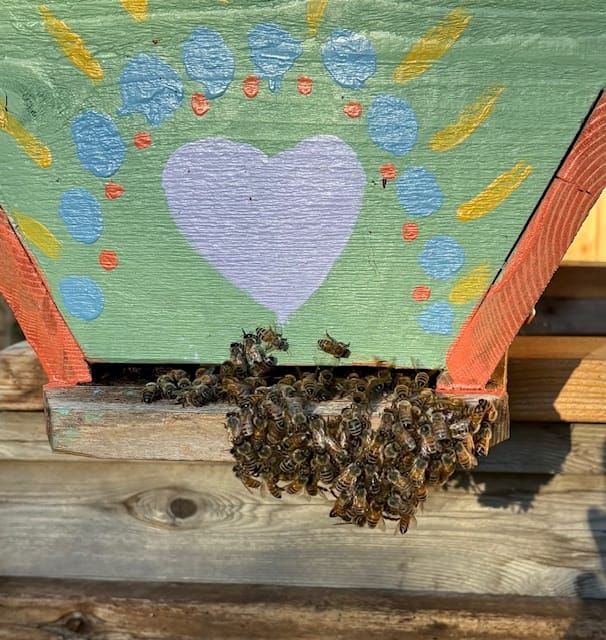
Perhaps one of the reasons bees are so intriguing to me is that they are true matriarchal societies. Their leader and their workers are all female despite what animated movies annoyingly portray. God forbid Jerry Seinfeld be ousted from his acting masterpiece Bee Movie. Male bees are called drones and there are much fewer of them in a colony because they don't do as much and take up a lot of resources. Huh. Male bees also do not have stingers and therefor, you guessed it, can't sting. The one important role of a drone bee is to impregnate virgin queens from other colonies and thus spread their own queen mother's genes. Once the temperature drops and the hive needs to start conserving, the drones get ejected, left to die outside the warmth of their colony. Harsh, I know. Another thing that fascinates me are that bees are less individual beings, though they do have distinct traits, behaviors and emotions are more of a collective. Their lifespan is short (1.5-6 months for workers, 8-10 weeks for drones, 2-5 years for a queen) and their efforts tireless. The effort and the attention of the entire colony is to work together to support the queen who lays up to TWO THOUSAND eggs per day. Jesus. But the communication of bees is complex. They fly in patterns called "waggle dances" the name of which personally I think diminishes the highly symbolic and beautifully complex movements to tell other workers the exact distance and location of larger sources of nectar, some of which can be miles away. They fan the hive to cool it down in turns, hang in a beard shape (called bearding) outside the box when it's too hot, will pass of pollen to other bees when overloaded, will even bring water to thirsty community members or fan them when they are tired. But make no mistake, it is survival for the colony these astounding creatures are after and when one is dying they will be unceremoniously removed in order to keep the rest safe from potential disease. And as a note, because we all associate bees with honey, a fun little fact is that in her entire lifetime a worker bee will produce around 1/12 of a teaspoon of honey.
I could say more but I'll let you do your own research if this is as amazing to you as it is to me. To bring it back to why bees matter to me on a personal level I think it's because they are so very different than us. And if we as humans didn't get in the damn way all the time, they would be a perfect example of species ability to thrive in extreme collectivism. It's not exactly socialism in the human political sense but it's close. There is a natural order to things in the hive and its one the benefits the whole world and everything that lives on and in it. It's a symbiotic relationship with all living things. And as such, I think we need to be responsible and reciprocal partners in order for their to be some kind of relational equity. Very briefly here's that you can do. First off, in case you needed another reason, please don't use pesticides. Second, keep a shallow water dish with rocks and sticks for bees to land on in your yard. Leave the grass, dandelions and yard waste and plant pollen rich native flowers and plants.
Now that I'm in Australia, I'm learning about our native bees here. I have a lot to learn about the 2000 species of tiny and stingless ones that live in colonies and the solitary ones that live in ground burrows and don't make honey. I'm hoping they will be willing to get to know me too, like the other members of my welcome crew here were when I first arrived. My mentor firmly believes in talking to bees, even singing to them. Showing them who you are and inviting them to stay. Warning them if there are going to be the loud and disruptive noises of construction or fireworks. I've even convince my initially reluctant husband to talk to our bees, something he does eagerly now every day. I think he has fallen in love too. Like most living things we share this planet with, we could learn a lot if we just paid attention and stopped thinking we were better, different than everything else. It could not be more obvious to me that we aren't. We may be capable of many amazing things as humans but we sure fuck a lot of shit up too. Perhaps the origin of that destruction comes from individualism and the quest for power. Maybe if we took a little less, shared a little more and all did our part without our ego getting in the way of everything, everyone would have enough. And at the risk of alienating some of you, maybe we should let the women take over for a while?