Learning Welfare in the Time of Information Warfare
When my husband was in town last month we attended a session at the Byron Writers Festival. It was a group of 4 aboriginal writers and activists discussing their relationship to country and particularly to water. They were not direct in their answers or their messages, instead telling stories or following the winding imagery of their minds and memories. Stories of pulling meals from the ocean each day and stories of the first time they remember touching a particular body of water or returning to it. A poem was shared, a song was sung.
When a white man asked a blunt question at the end, a question that was unsurprisingly really both a comment and a request with an inflection at the end about the secrecy of so many of their stories and wisdom, about how much we white people could learn from their practices, their medicine, their understanding of the world, the response was the only brief one given during the conversation. He had asked a speaker to share something valuable and she simply said no. We had no right to that information. And that us finally being ready to hear it despite centuries of colonization and oppression did not mean that they were under any obligation to share.
What they did speak about was how learning is earned.
What a radical idea for those of us who have grown accustomed to asking the internet every big and small question we have and getting an answer immediately. What a radical idea when we reconcile it with the reduction of everything into bite sized ai generated "facts" that eliminate the need for human involvement, contact or effort. To generations of people who no longer even know what it was like to have to hunt down several books from various libraries to piece together a likely truth. Who had to call our parents instead of hoping on YouTube to be educated on how to fix something or navigate a new experience. Or god forbid just figure it how through trial and error like our ancestors once had to. Who had to wait and to work for answers.
To be honest, this is all quite scary and incredibly sad to me. Humans don't need information, they need meaning. We need to learn from each other. We need so much more depth and nuance and context and relevance in what has now become a data driven upward and forward only moving culture. We move so fast, each company so desperate to get there (wherever there is) first that we don't take time to think about consequences. To consider what's really in our best interest. To understand that different choices work better than others for different people. To contemplate other experiences and interpretations. All of this has lead, as more and more people are finally catching on to, the potential and fast approaching extinction of humanity. What short sightedness. What greed. What arrogance.
Australians are natural storytellers. They meander and ramble and emphasize and gesture. They are expressive in a way Americans are not. Most of the time it is good natured, open, playful. Often its sarcastic and sometimes its rude and divisive. But it's in their nature to say it all. Conversation here is meant to not simply pass along information but to connect. Details are tertiary to context and personal meaning. People are not afraid to take their time embellishing directions with an abundant use of descriptive landmarks and stories. When you pass a neighbor on the way to the market expect to stop and hear about anything from their home renovations to their childhood illness and the paths they had to navigate to receive treatment. People have tea here. It's presented as a casual invitation but a commitment to a 2 + hour event. There is no shyness to this nor withholding. In fact I believe the opposite would be a surprise and seen as rude.
This is a generalization of course but it's impossible not to see the difference, even for someone whose career centers around the listening to personal stories. In America we have streamlined communication to the bare minimum. Get your point across and get it across quickly. No one has time for chit chat or irrelevant additions. Text don't call. If you are going to post something and want to get someone to read, look at or watch it, it better be very short. A pretty picture and soundbite. Other humans; full of all their feelings and thoughts and ideas and issues are frustrating. We are impatient. We are self important. We can't be bothered or slowed down to earn our information. To have the 20 minute long conversation in passing that may eventually get you the answer to the question you asked along with the relational investment.
Following the above mentioned festival workshop my husband and I watched a documentary about David Gulpilil, a well know aboriginal actor and dancer. The movie was slow and nonlinear in a way that amplified the discomfort those of us from Western cultures feel when trying to let a story unfold. I found myself wrestling with the pace, the lack of action, the "where is this going?" question. In that way it helped me understand the influence my own culture has had on me and the lens through which I see storytelling. It required being present and simply letting the experience unfold without my personal comfort or preferences or desire for a specific kind of learning or transformation to guide it. In short, it wasn't for or about me. It was there and I could take or leave what it was. It would be up to me to make meaning from it, to integrate and learn from it and it wasn't going to spoon feed me something simple, straightforward or easy to digest. I had to work for it, to earn it. Ah. Ah-ha.
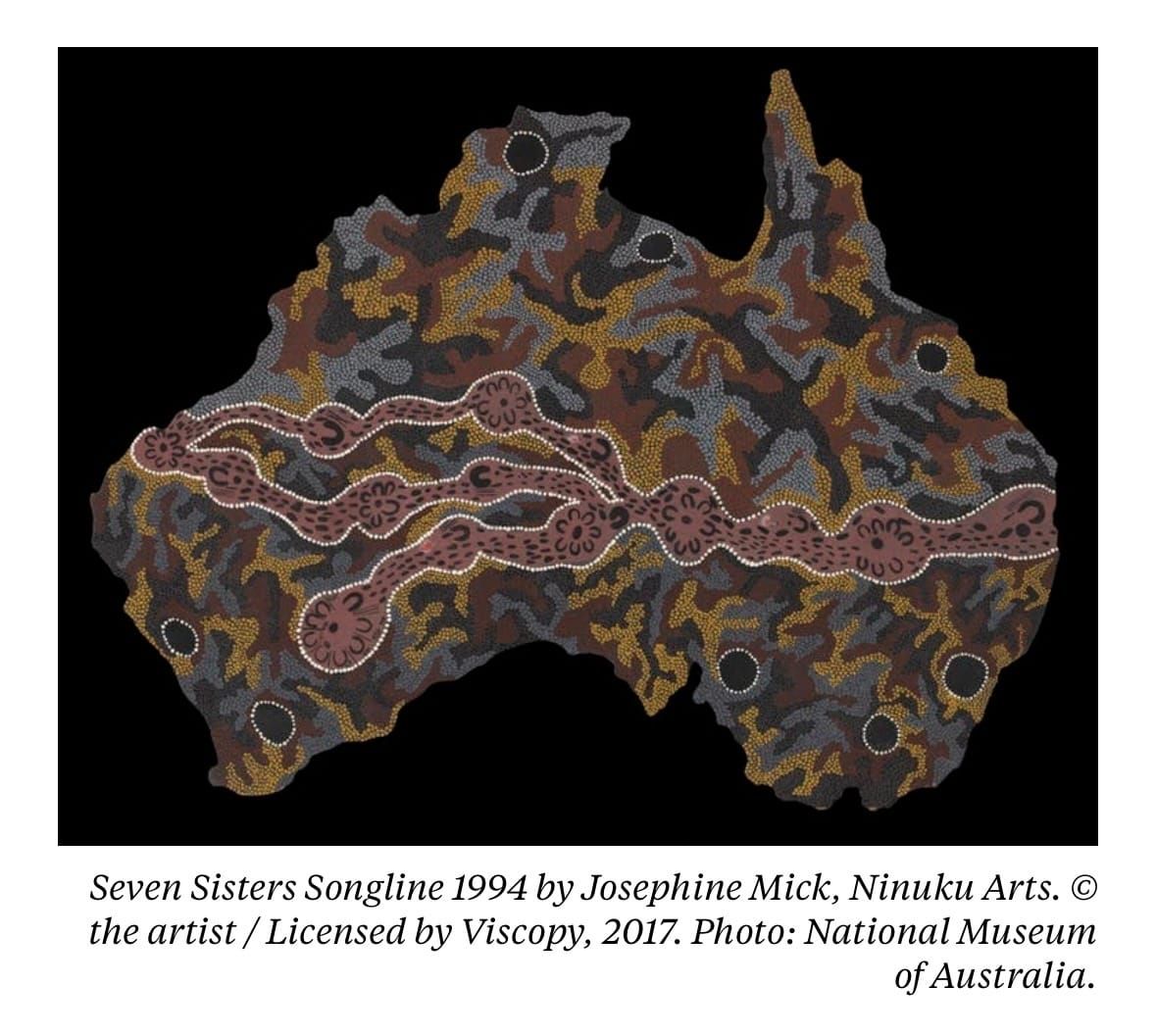
Inspired now, I wanted to learn more about songlines. As I understand it, songlines are knowledge pathways; ancient and interconnected navigational maps of land, sea and sky that communicate pathways of passage and link physical sites and locations significant for food, resources and safe passage and contain embedded spiritual and cultural significance including laws and kinship rules communicated through song cycles. They allow aboriginal peoples to travel respectfully through other mobs territory. Many are secret and very very old. Colonization has resulted in the paving over of parts of many of them with highways. They are hard to describe because non indigenous peoples don't have something comparable. Our minds also have been trained to not really work that way so even trying to define them feels wildly lacking.
Since being here, I have been training and working with a local wildlife rescue. I'm learning all about the native birds and mammals; what they are, what they do, where they do it and how to help them when the get into mostly human created trouble. My fellow volunteers are mostly 70 years old and up and most are women. All of them are white so I made no comparison to the way they transfer information and the beauty and complexity and collective history of a songline but there is something in it that is a different version of learning than I am used to. When I meet with more experienced volunteers, those meant to mentor me, I now know that I will need to be patient. Asking questions won't get my anywhere faster. They are going to direct the flow and it's not going to be direct or specific. Taking notes will look like a novella rather than a list. The knowledge is imparted slowly and though engagement. I have no right to it but I am showing up, ready to listen, hopeful that they will feel like sharing. It is slow. At times I feel more confused than I before I arrived. But I am confident that it's not just the only path but the right one.
The world beyond Australia may be moving faster than we are here. But it's not moving better nor is it necessarily moving in the right direction. I'm hopeful that the land and people here will outlast those determined to race to the finish line. In the end we are all going to end up in the same place. The end of the story. But I'm grateful that I have had the chance here to learn a different way.